
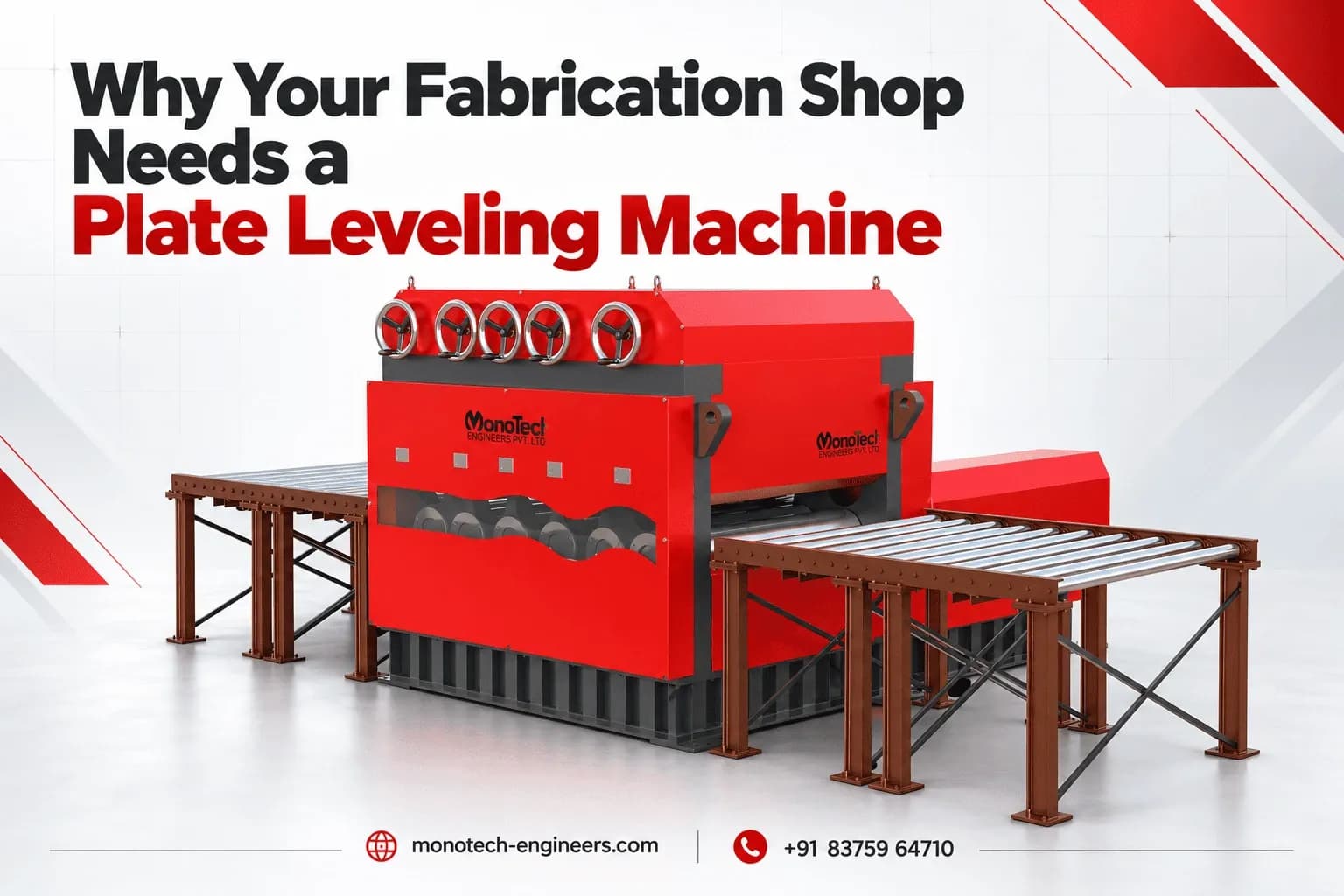
Why Your Fabrication Shop Needs a Plate Leveling Machine
A plate leveling machine can help solve a production problem that often goes unnoticed until bending, welding, or assembly begins: distorted metal plates.
Your cutting machine may produce the correct profile, but the component can still arrive at the next workstation with bowing or unevenness. Operators then spend time adjusting clamps, checking gaps, and correcting the material before continuing the job.
When this happens repeatedly, flatness becomes a production issue rather than an occasional inspection concern.
For workshops looking to improve material preparation, Monotech Engineers plate leveling machine options provide a starting point for discussing the right straightening solution. Selecting suitable equipment requires a clear understanding of your material, component geometry, production volume, and expected flatness.
Why Plate Flatness Matters in Fabrication
A component can meet its length and width requirements while still creating difficulties because it does not sit flat.
Consider a mounting plate prepared for a welded assembly. Its holes and outer profile may be correct, but a curved surface can make positioning difficult. The operator may need additional restraint or correction before the part aligns with surrounding components.
Similar issues can affect sheet metal panels, fabricated brackets, base plates, and laser-cut parts.
Better flatness gives the next operation a more consistent starting condition. It does not replace correct tooling, welding procedures, or inspection, but it helps remove one source of variation from the workflow.
What Does a Plate Leveling Machine Do?
A plate leveling machine applies controlled deformation to correct unwanted curvature in metal plates or suitable components. In roller-based equipment, the material passes through an arrangement of rollers that bend it progressively to improve flatness.
The outcome depends on several factors, including material strength, thickness, width, incoming distortion, and machine settings.
The terms plate leveling machine and plate straightening machine are often used in related applications. However, the equipment behind those names can differ. Buyers should discuss the actual process and expected results with the manufacturer.
A useful specification should answer a practical question: can the proposed machine process your components to the required flatness under agreed inspection conditions?
1. Reduce Time Spent on Repeated Correction
Manual correction can appear manageable when viewed one component at a time. Across a full batch, however, it can consume considerable operator attention.
A typical problem part may require several steps:
Inspection after cutting.
Transfer to a correction area.
Manual straightening.
Another flatness check.
Further adjustment before release.
A suitable plate straightening machine can help bring recurring correction work into a defined production process.
Before evaluating equipment, record the time spent correcting your most common parts. Include handling and inspection time, as well as the correction itself. This creates a realistic baseline for assessing potential improvements.
2. Provide More Consistent Blanks for Bending
Press brake operators need components that can be positioned reliably against supports and backgauges. Distorted blanks can complicate this process, particularly when producing repeat batches.
Improving flatness before bending can make positioning and checking more manageable.
For example, a panel that sits unevenly may require additional attention before the first bend. Addressing the distortion earlier helps the operator begin with a more consistent blank.
Bending accuracy still depends on material variation, tooling, machine setup, and springback compensation. A sheet metal leveling machine supports the preparation stage within that wider process.
3. Improve Welding Fit-Up
Welding teams often spend time bringing components into alignment before making the first weld.
When plates have uneven contact surfaces, the assembly may require additional clamping or adjustment. This can increase preparation time and make repeat jobs less predictable.
A flatter incoming component can help improve the starting fit between mating parts. It can also make it easier to identify whether a gap comes from the plate condition or another assembly issue.
Welding can introduce fresh distortion, so leveling should be considered alongside suitable joint design, heat control, and welding sequence.
4. Make Assembly Problems Easier to Control
Assembly problems can originate several operations earlier. A component may pass profile inspection but later require adjustment because its surface does not align correctly with the assembly.
By checking and correcting flatness at an appropriate stage, workshops can address these problems before additional work is completed.
This is particularly useful when parts must sit against a reference surface or align with several adjoining components.
The key is to define what acceptable flatness means for the application. Use a specified tolerance and measurement method instead of relying only on visual judgment.
5. Create a More Predictable Production Flow
Repeated correction interrupts scheduling. Operators may wait for a part to return from straightening, while inspection teams check the same component more than once.
Introducing a planned leveling stage can help organize work that is already taking place informally across the shop floor.
The benefit depends on the production mix. A workshop processing occasional distorted plates has different needs from a manufacturer handling repeat batches every day.
Choose equipment around the work you actually perform, including your most frequent materials and component sizes.
Monotech Engineers Plate Leveling Machine Options
Different workshops require different levels of operator involvement and process control. When evaluating a Monotech Engineers plate leveling machine, discuss how each straightening machine configuration fits your production requirements.
Electro Mechanical Straightening Machine
An Electro Mechanical Straightening Machine is an option to discuss when assessing a mechanically driven straightening solution.
The evaluation should cover the adjustment method, feeding arrangement, material capacity, and operator responsibilities. Ask how the proposed model will handle your typical plate distortion and how settings are established for different jobs.
A demonstration with actual components helps clarify whether the configuration suits your workflow.
Semi Automatic Straightening Machine
A Semi Automatic Straightening Machine combines operator involvement with automated functions.
The precise division of tasks depends on the machine configuration. During evaluation, establish which steps the operator performs and which steps the machine controls.
For workshops handling varied jobs, this discussion should include setup changes, component loading, inspection, and the practical time required between batches.
Servo Based Straightening Machine
A Servo Based Straightening Machine uses servo control for designated machine movements or adjustments, depending on its design.
When considering this option, ask which functions are servo controlled and how they contribute to the required process.
If your workshop handles repeat components, discuss available setting controls, job recall where offered, and the procedure for verifying results after a changeover. Servo control should be assessed against demonstrated production needs and output quality.
Fully Automatic Straightening Machine
A Fully Automatic Straightening Machine is relevant when evaluating a higher degree of process automation.
Define the automation scope clearly. Feeding, straightening, measurement, sorting, and unloading are separate functions; their inclusion must be confirmed for the proposed system.
For repeat production, assess the complete cycle with representative parts. Include loading requirements, changeovers, inspection, and the handling of components that need further attention.
How to Select the Right Plate Leveling Machine
Start with a written application brief. This helps Monotech Engineers assess your requirements and provides a consistent basis for comparing configurations.
Specify Material Properties
Provide the material grade and yield strength wherever available. Plates of equal thickness can require different processing conditions because their strength differs.
Define the Working Range
Include minimum and maximum thickness, plate width, part length, and typical component weight. Identify your regular production range separately from occasional jobs.
Share Drawings and Sample Parts
Holes, slots, narrow sections, and irregular profiles can influence processing. Representative drawings and samples give the manufacturer a clearer understanding of the application.
Agree on Flatness Requirements
State the required tolerance, measurement method, and inspection condition. Confirm whether surface appearance or roller marking is important.
Review Operation and Maintenance
Consider operator training, access for cleaning, adjustment procedures, spare parts, and service support. These factors affect everyday usability throughout the machine’s working life.
Evaluate Value Beyond Purchase Price
The lowest quotation does not explain how well a machine fits your production.
Assess the investment against measurable issues such as correction time, additional handling, delayed assemblies, and rejected components.
Compare the current process with a representative machine trial. Record the incoming condition, processing time, final flatness, and any additional work required.
This gives your team practical evidence for selecting equipment.
Discuss Your Straightening Requirements with Monotech Engineers
If plate distortion regularly interrupts bending, welding, or assembly, it is worth reviewing how material preparation fits into your production process.
Monotech Engineers plate leveling machine discussions can cover Electro Mechanical Straightening Machine, Semi Automatic Straightening Machine, Servo Based Straightening Machine, and Fully Automatic Straightening Machine options according to your application.
Share your material specifications, component drawings, production targets, and required flatness to establish the right basis for selection.
Contact Monotech Engineers: +91 83759 64710
FAQs: Plate Leveling Machine
1. Why does a fabrication shop need a plate leveling machine?
A plate leveling machine helps correct unwanted plate curvature before subsequent operations. It is useful when recurring flatness problems lead to extra positioning, manual correction, or assembly adjustments.
2. Which Monotech Engineers straightening machine should I choose?
Discuss the Electro Mechanical, Semi Automatic, Servo Based, and Fully Automatic Straightening Machine options against your material range, component geometry, production volume, and required operator involvement. Confirm suitability through application review and sample trials.
3. Can a plate leveling machine process laser-cut components?
Suitable equipment can process many laser-cut components. The result depends on thickness, material strength, part dimensions, cut-outs, and machine design. Trials with your actual parts are essential for confirming suitability.
4. What determines plate leveling machine capacity?
Capacity depends on more than plate thickness. Material yield strength, width, component geometry, incoming distortion, and the required final flatness also influence selection.
5. What information should I share before requesting a quotation?
Provide material grades, yield strength, thickness and width ranges, component drawings, production quantity, and required flatness. Photographs or samples of typical distorted parts can also help explain the application.